Category
Keep Paddling!
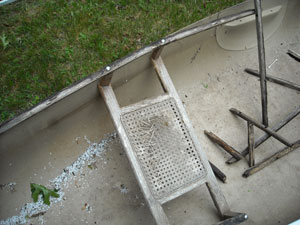 My husband and I own a canoe, but for years the only action we took re canoeing was to talk about how we ought to take it out on one of the marshes or kettle ponds before the summer ended.
But we’d got rid of the car with the roof racks and it always seemed like too much trouble to have to figure on a new way to strap the thing on top, so there it sat, season after season, on sawhorses beside the garage.
This year, however, as the tourists began to arrive, I found myself looking at their kayaks with envy, so I told my husband it was time we went canoeing again.
He went to work, cleaning years of accumulated dirt off the fiberglass shell and fixing a broken thwart, while I rummaged in the attic and located the paddles, the life jackets and the dry bag.
At a local outdoor store we found a carrying kit suitable for hauling a canoe short distances and we bought it and drove straight home and loaded Sacagawea onto the car and took her to Salt Pond.
Respect Yourself
 It was the beginning of rush hour, and the Green Line train was almost full, forcing us to stand. As soon as we boarded I grabbed the bar on the back of the seat nearest me and adjusted my stance to absorb the jerk which I knew would follow as soon as we started.
I noticed a man sitting in the aisle seat a few rows back, and two things about him immediately grabbed my attention. One, he was sitting with his back ramrod straight, and two, he was ex-military, wearing a black corduroy baseball cap embroidered in red and yellow letters that said "Marine Veteran" and a badge that read "Vietnam Veteran" above the pocket of his denim jacket.
His self-assurance was fascinating, yet I also found his eyes-front posture intimidating because of the oversize aviator sunglasses that hid half of his handsome face, making it impossible to read his expression. I aimed my gaze over his head and out the window and wondered what he'd experienced in that war that was more humiliating to those who fought in it than any other in America's history, and how it had shaped him.
Spring Cleaning
 During the first week of spring, the temperature dipped into the twenties, the daffodils lay prostrate on the walk, and I devoted an entire day to cleaning out my files.
I usually purge them in January to get a fresh start on the year, but I had failed to do so, not only this past January, but also in January of 2011.
So it was time—past time. Too much paper never sorts itself out. The trivial and the important were jammed together, both in the cabinet and in my head.
I soon realized that my neglect to use organization as a strategic planning tool (see Wildly Organized) was symbolic of an ambivalence about where I am in my professional life.
Yes Men Transformed
 In Free Agent Nation, Daniel Pink suggests watching two films to get an idea of how the world of work has changed since the middle of the twentieth century.
The Man in the Gray Flannel Suit (1956) is about a public relations executive, the Organization Man of the 1950s.
Jerry Maguire (1996) is the story of a West Coast sports agent who navigates today's freewheeling entrepreneurial culture.
But what struck me on the snowy afternoon that I watched these movies back to back was not so much how the culture of work has changed, but how much it has remained the same.
Worry—Again!
 I usually begin thinking about a column a few weeks before I sit down to write it, but the month of January flew by so quickly and the approach of the deadline for this month threw me into a panic.
How could I possibly attend to the client work on my calendar, prepare for a strategic planning summit a week from now, and write a newsletter?
The more I stared at the calendar, trying to find open space, the more inaccessible a topic seemed. I not only couldn’t think of anything to write about—I also couldn’t remember anything I’d written in the eight years I’ve been producing this newsletter!
Black Hole
Long ago, I vowed never to write another column about resumes, but something a client said to me a few weeks after being laid off by the Fortune 200 company where she had worked for over fifteen years changed my mind.
"I don’t want anymore black hole resumes," she said emphatically.
For her to be able to speak with such clarity, even while recovering from the shock of being let go, was a cause for celebration. It was a huge step forward because in taking it she was rejecting the idea of another job in favor of work, as a consultant, free agent, business owner.
Court Street Thrift Boutique
 I am writing this on the Friday morning after Thanksgiving. Because I like to finish one holiday before leaping ahead to the next, I am making this a quiet day, a space to reflect on what this annual feast, now so narrowly focused on eating and football, really means.
The actual history of Thanksgiving is far more complex, both messier and richer, than the story everyone knows about the Pilgrims inviting the Indians to dinner.
We hear very little about how the Pilgrims stole seed corn from the Nauset Indians of Cape Cod a few days after they arrived, or the fact that the land around Plymouth had already been cleared and cultivated by Pokanokets who had been wiped out by disease shortly before the newcomers arrived, or that when Native American neighbors came to help the Pilgrims they usually showed up naked!
We cheat ourselves when we settle for an oversimplified view of history because the arrival of the Mayflower in Plymouth represents a nitty-gritty struggle for survival which is as relevant today as it was for the residents of Plymouth in the 1620s.
Drop the Shock and Awe
 Every event or conversation that upsets or displeases us is made up of two components: what actually happens in real time, and what our head does with it afterwards. We have little or no control over many of the difficult things which occur in our lives, but we can change our response to them.
A good starting point in keeping our minds from spinning out of control is to learn how to "drop the shock and awe." We do this by making a choice not to be surprised—once again—by behavior that we know from past experience is consistent with a particular person.
Because we already know what to expect, we can eliminate, or at least shorten, the time we spend trying to build a case for why we find another person's thinking, words or actions unacceptable.
Professional Dysfunction
 I’ve been aware for some time now that what causes my clients the most pain in their professional lives is not the weight of their responsibilities, the heavier workload due to the economic downturn.
What leads to frustration, sometimes despair, are those difficult or even hostile exchanges with specific people in the work environment, often the boss. These interactions play out in predictable patterns which one of my clients recently described in great detail.
The scene was all-too-familiar: her boss kept calling her again and again, each time with a new demand, neither asking nor caring how the interruption would affect what she was currently working on, expecting her to be able to shift gears immediately, insisting that everything was urgent. It was making her numb.
More Often Than Not
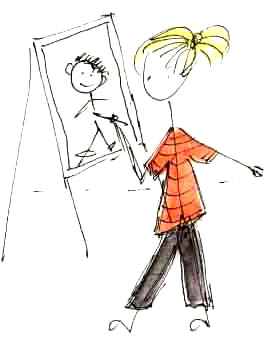 I regularly work with clients who have creative goals—making pottery, writing poetry, actually using the sketch pad they've purchased or been given as a gift. Sometimes these aspirations come up almost apologetically: "Of course, it's not practical and I have so little time, but what I'd really like to be doing is—"
Frequently they come to light in an exercise where clients write stories about experiences in their lives which gave them a deep sense of personal satisfaction, e.g., this description of a drawing class written by a woman who manages construction projects: “I loved how I felt when I was doing these drawings. There was a connection between my soul and the paper.”
Occasionally, the need to put hands to clay or pen to paper has become so important to a client that the failure to be able to do it become the focal point of our discussion. This is always exciting to me because it is an unconscious recognition of the link between the artistic urge and transforming a work life.
In my clients' frustration I hear the struggle to claim the creative space which is essential to a genuine transition. The challenge for them (and for me) is to actuate these seemingly non-productive, impractical pursuits to serve the longer term goal of professional fulfillment.